

A bag of vegetables, a warm pretzel, a conversation that lasts longer than the coffee: the Viktualienmarkt still makes room for everyday Munich. Look a little closer and you will find a market that keeps changing, from generations of produce sellers to a pastry chef with her own tiny bakehouse and two friends who put the potato centre stage.
To understand it, bring an appetite and give yourself time to stop. The interesting part is often the person behind the counter.
Why the Viktualienmarkt began in 1807
The market’s story starts with a space problem. Marienplatz, then known as Schrannenplatz, had become too cramped for the city’s trade in grain and other agricultural goods. On 2 May 1807, King Max I Joseph ordered part of the market to move to the area between the Heilig-Geist church and Frauenstraße. The green market had a new home. The later name Viktualien refers to food or provisions. The market authority’s history records that beginning.
It grew in stages. The grounds expanded between 1823 and 1829; the Schrannenhalle followed in 1852, and the fish market moved to Westenriederstraße in 1855. Those changes explain why the area feels like a collection of small spaces rather than a single, neatly planned square.
The Second World War badly damaged the market. Munich rebuilt it, and the memorial fountains to local performers and comedians became part of its identity. Since November 1975 the market has been a pedestrian area. This is a place shaped by rebuilding and reinvention as well as continuity.
The old hands: long histories behind today’s counters
An important distinction: 1807 is the founding date of the market, not the opening date of every business here today. Ownership, buildings and stall names have changed. The traders below offer documented examples of that continuity; they are not presented as unchanged stalls from opening day.
Obst und Gemüse Tretter: the market traders’ directory dates this family business to 3 August 1885. A produce stall is a good place to see the market’s original purpose still at work: people choosing ingredients to take home, rather than simply buying a snack. Read the traders’ account of Tretter’s history.
Karnoll’s Back- und Kaffeestandl: Munich Tourism traces the business to 1974. Coffee and baked goods make a simple starting point for a market visit. You do not need a complicated tasting plan to appreciate the pleasure of a fresh pretzel and a short pause while the stalls get busy.
Fisch Witte: the Witte family’s chapter at the market began in 1985, according to the business’s own account. Its fish counter is another reminder that the market’s character comes from specialist food shops, not just places to eat on the spot.
Honighäus’l: Wolfgang Kager’s honey business dates its start to 1 May 1995. The shop describes its story and range, from local honey to varieties from further afield. It is a useful stop if you want a food souvenir you can actually use after the holiday.

Lea Zapf: Munich pastry craft with a fresh point of view
Lea Zapf opened her Marktpatisserie in June 2020. Her small stand brought an ambitious pastry counter into the market: cream-filled choux pastries, brioche and other carefully made sweet things. This profile of the patisserie documents that opening and some of its specialities.
Zapf is a master confectioner, and her interview about working in the craft makes the skill behind the counter clear. For a visitor, the appeal is straightforward: give a beautifully made pastry the attention you might normally reserve for a restaurant dessert. Choose what is on the counter that day instead of arriving with a fixed shopping list.
Her presence also changes how a market visit can unfold. You might come for vegetables, meet someone for coffee, and end up staying for something sweet. That mix of shopping and lingering helps keep the place part of daily city life.
Caspar Plautz: the two friends behind the potato stand
The potato stand you may have heard about is Caspar Plautz. Friends Theo Lindinger and Dominik Klier began their market business in November 2017. Their own introduction to the stand describes a kitchen built around regional, seasonal potato dishes, alongside a wide range of potatoes to buy for cooking at home.
The menu gives the humble potato plenty of room: a baked potato can become a meal with herbs, vegetables, mushrooms, fish or meat, depending on the current selection. There are vegetarian and vegan dishes, but check the day’s ingredients rather than assuming every topping suits every diet. The current menu is a better guide than an old photograph or a remembered weekly special.
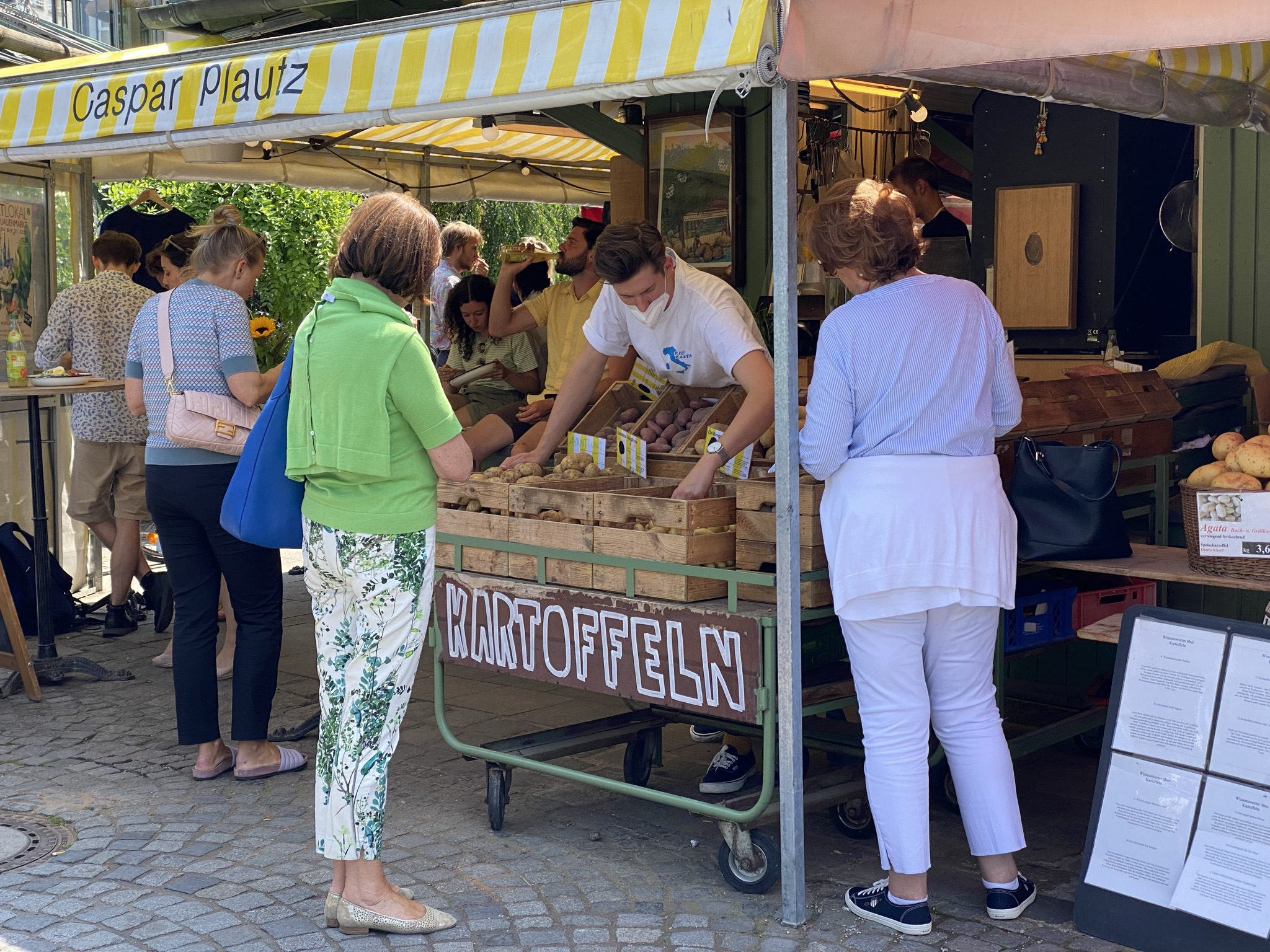
This is a good example of a newer business working with the market’s food-selling roots. You can eat lunch, ask about a variety, and leave with potatoes for dinner. The counter still does a market stall’s job while giving people another reason to come.
How to visit the market today
- Make a weekday or Saturday visit. Individual stalls set their own hours and some close earlier than others. Check the businesses you particularly want to see before travelling; Sunday is not the day to expect the full food-shopping market.
- Start with a slow lap. Notice the produce, butchers, flowers and specialist counters before choosing where to eat.
- Leave room for both savoury and sweet. A potato lunch and a pastry stop make a very different visit from a quick walk straight through.
- Keep the walkways clear. People are working and doing their shopping here. Step aside to take photographs and ask before making someone the subject of a close-up.
- Bring a shopping bag. The best souvenir might be something for your next meal.
For current practical information, use Munich’s Viktualienmarkt guide. To explore with food and local context, see our More Than Viktualienmarkt Food Tour. The independent stall recommendations in this article are not a promise that every business will feature on every departure.
Visiting in winter? Our Munich Christmas market planning guide helps you turn the surrounding Old Town into a relaxed festive food walk.
Researched and checked on 23 October 2026. Business menus and opening times can change. Images are from the existing Fork & Walk Munich photo library and are not presented as photographs taken in 2026.